
Das Konzept verstehen
Wir können mechanische Wasserfiltration definieren als einen Prozess, bei dem unbehandeltes Wasser oder Rohwasser durch ein Filterelement geleitet wird, das die Weiterströmung von Schwebstoffen oder Partikeln verhindert. Es handelt sich um ein weit verbreitetes Verfahren in verschiedenen Industriezweigen, in denen Wasser zum Einsatz kommt – etwa in der Lebensmittelindustrie, in Wasseraufbereitungsanlagen und Wasserwerken, um nur einige zu nennen. Typische Verunreinigungen sind Ton, Sand, organisches Material und Schutt.
Ein Filtrationsprozess kann je nach Art der Verunreinigungen und dem für das Prozesswasser erforderlichen Reinheitsgrad in mehrere Stufen unterteilt werden.
Die erste Filterstufe konzentriert sich auf die Entfernung grober Schwebstoffe, die unterschiedlich groß und verschiedenster Art sein können. Diese Schwebstoffe werden üblicherweise mithilfe eines einfachen Filterelements mit einem Abscheidegrad von 10 µm zurückgehalten. Auch wenn das Wasser klar und durchsichtig erscheint, bedeutet dies nicht, dass es frei von Verunreinigungen oder Partikeln ist. Selbst in klarem Trinkwasser können sich noch kleine Partikel befinden, die für das bloße Auge unsichtbar sind.
Nach dieser ersten Stufe können in geringer Konzentration noch weitere Stoffe mit Abmessungen von 0,001 bis 0,01 Mikrometern vorhanden sein, wie etwa Zuckermoleküle, Viren und Bakterien. Auf einer noch kleineren Größenebene (unter 0,001 Mikrometer) finden sich gelöste Salze und Metallionen. Grundsätzlich ließe sich jeder im Wasser enthaltene Stoff mit der geeigneten Filtertechnik entfernen. Aus diesem Grund wird die mechanische Filtration sehr häufig in Kombination mit anderen Filtrationsverfahren eingesetzt, beispielsweise um gelöste Partikel zu entfernen.
Filterauswahl
It is important to choose a filter type and filtration degree appropriate to the nature of the particles and contaminants to be treated. For instance, a filter that separates sand could be less effective in the filtration of colloidal particles. In addition, the level of automation of the cleaning cycle required in the system plays an equally important role in the design of the right solution.
Unsere dolphin filter decken ein breites Spektrum an Filtrationsgraden ab und lassen sich daher in mehrstufigen Lösungen einsetzen, um den Großteil der im Prozesswasser enthaltenen Partikel zu erfassen. Der Filtrationsgrad wird individuell auf die Anforderungen Ihrer Anlage abgestimmt.
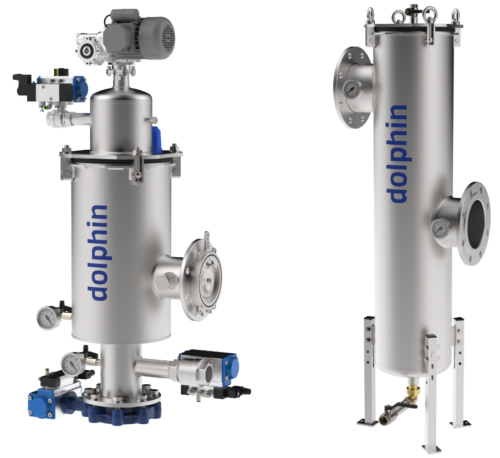
Je nach Art der Reinigung des Filterelements sind dolphin-Filter als automatische oder selbstreinigende Filter, nicht-automatische Filter sowie als manuelle oder halbautomatische Filter erhältlich.
- Nicht-automatische Filter: der Bediener muss den Filter öffnen, um das Filterelement zu reinigen oder auszutauschen, wenn die Ansammlung von Feststoffen auf der Filteroberfläche einen Druckabfall verursacht, der den zulässigen Wert überschreitet.
- Manuelle oder halbautomatische Filter: der Bediener kann das Filterelement reinigen oder austauschen, ohne den Filter zu öffnen.
- Automatische oder selbstreinigende Filter: der Reinigungsvorgang läuft vollautomatisch ab und erfordert kein Eingreifen des Bedieners. Sensoren erfassen den erhöhten Druckabfall und lösen den Reinigungszyklus aus.
Benötigen Sie eine wirksame Filtration?
Setzen Sie sich mit uns in Verbindung, und wir entwickeln eine auf Ihre Bedürfnisse zugeschnittene Lösung.